Side Extension, Braintree
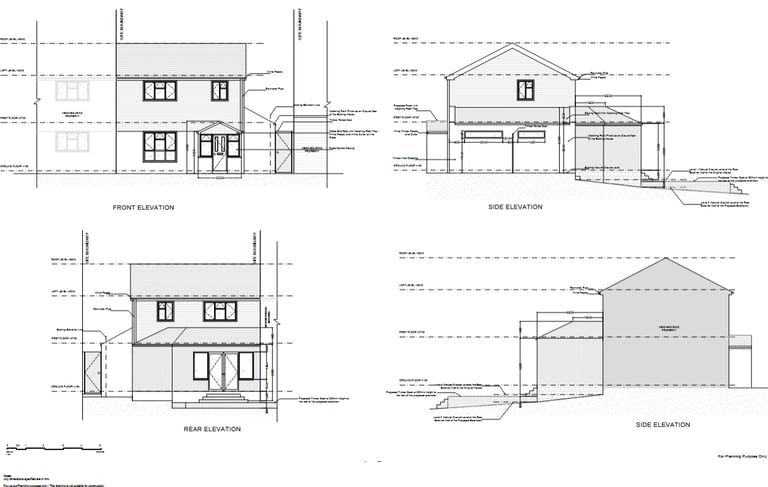
Proposing a single storey side extension following the demolition of the existing side extension that didn’t maximise the allowable width as per Permitted Development rights, UK. There was also a permitted development compliant front porch included in the proposal.
Project Overview
This project followed on from a previously submitted application for a large rear extension under the Prior Approval route. The property is a semi-detached dwelling located in a residential area of Braintree, Essex, UK. The existing house includes a rear conservatory and an earlier single-storey side extension. After submitting the prior approval application for the rear extension to the local council, a second application was prepared to propose an additional side extension and a new front porch under permitted development rights.
The intention of this subsequent proposal was to maximise the allowable footprint of the side extension in accordance with permitted development regulations, while also improving the entrance to the dwelling through the addition of a front porch. Although all of the proposed works were originally designed as part of a single cohesive scheme, discussions with the local authority led to the decision to split the proposals into two separate applications. This approach allowed each element to be assessed under the most appropriate planning route and reduced the risk of refusal.
Client Brief
My role on this project was similar to my involvement in the earlier prior approval application. I was commissioned to prepare a full set of architectural drawings suitable for submission to the local authority. These included existing and proposed scaled plans, elevations, sections, a site location plan, and a block plan, all produced to meet the council’s validation requirements for a Lawful Development Certificate application.
The client chose to submit the application independently, meaning my responsibilities were limited to the preparation of the drawings and providing technical support throughout the process. This included responding to any design queries raised by the client and making revisions where required following feedback from the local authority after submission.
The site is located within an established residential neighbourhood in Braintree and consists of a semi-detached house with an existing rear conservatory and a single-storey side extension. One of the key constraints of the site was the significant change in ground levels, with a noticeable fall from the front of the property towards the rear garden.
This sloping condition introduced additional complexity to the project, as permitted development height limits are measured from existing ground level. As a result, careful consideration was required to ensure that both the side extension and the front porch remained fully compliant across varying ground levels. This necessitated a detailed review of the relevant permitted development guidance and precise height calculations throughout the design process.
Existing Site & Constraints
Design & Planning
The design process began with a thorough review of the local planning authority’s requirements for a Lawful Development Certificate application. These were largely standard and included existing and proposed plans, elevations, a site location plan, and block plans. In addition to these, section drawings were included to clearly demonstrate compliance with permitted development height limits, particularly in response to the sloping nature of the site.
The section drawings were essential in resolving head heights internally and ensuring that the proposed roof forms remained within the allowable limits. This was especially relevant for the side extension, where both eaves height and overall ridge height were critical factors.
The front porch was designed to comply fully with permitted development regulations. The external ground floor area was limited to no more than 3 square metres, and the overall height was restricted to a maximum of 3 metres measured from ground level.
Similarly, the single-storey side extension was designed with a pitched roof that complied with permitted development criteria. The maximum overall height was limited to 4.0 metres, measured from ground level to the highest point of the roof. Where the extension was within 2 metres of the boundary, the eaves height was carefully controlled to remain at or below 3.0 metres, which became one of the key design constraints.
Incorporating Client Feedback
Throughout the project, I maintained regular communication with the client, primarily via email. Any design issues encountered during the development of the drawings were clearly explained, and alternative solutions were discussed collaboratively. The client was kept informed of progress at each stage, ensuring transparency and alignment with his expectations.
Particular attention was given to resolving challenges related to internal head heights, eaves levels, and the relationship between the pitched roof and the flat roof element at its apex. These aspects required careful coordination and iterative refinement to balance design intent with regulatory compliance.
This project presented several challenges, largely due to the cumulative impact of previous extensions and the sloping nature of the site, both of which required a detailed and careful interpretation of permitted development rights. However, through thorough analysis, clear documentation, and close coordination with the client, the proposals were successfully resolved.
Ultimately, both the prior approval application for the rear extension and the lawful development application for the side extension and front porch were approved by the local authority, resulting in a positive outcome for the client.
Final Outcome